Islamic Science: The Discoveries That Shaped the Modern World
For five centuries, the fastest-moving science on earth was written in Arabic. This is how scholars of the Islamic world built algebra, explained how we see, wrote the textbooks that trained Europe's doctors, and designed machines centuries ahead of their time.
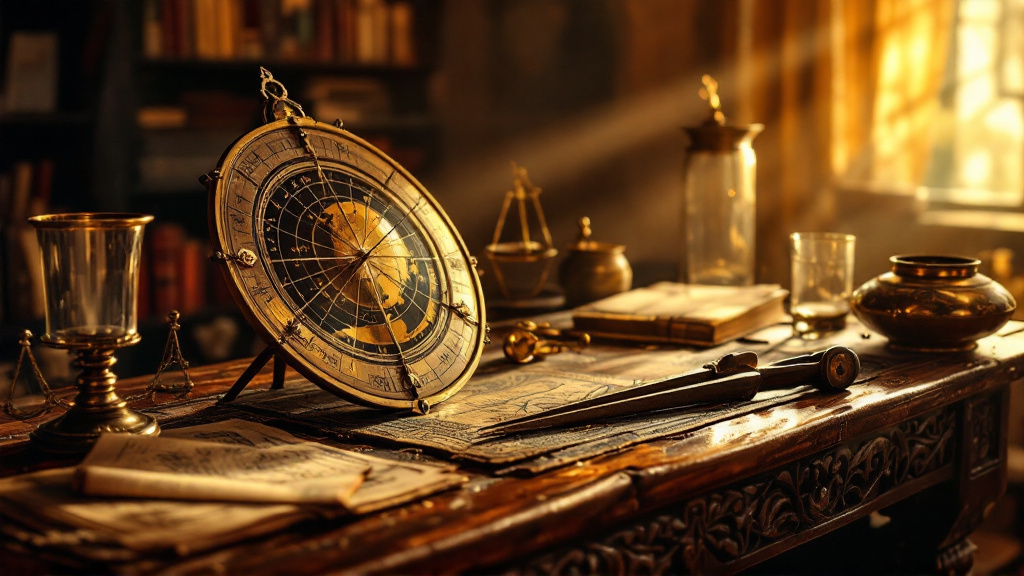
A new way of knowing
What set the science of the Islamic world apart was not only what it discovered, but how. Scholars did not simply trust the ancient authorities. They tested them.
The clearest example is Ibn al-Haytham (known in Europe as Alhazen, around 965 to 1040). Working in Cairo, he showed that we see because light enters the eye, overturning the old Greek idea that the eye sends out rays. He proved it with controlled experiments, including the earliest clear description of the camera obscura, and wrote it up in his Book of Optics. His insistence that a claim must be checked against evidence is one of the earliest statements of the experimental method, and it ran through the whole enterprise. Muslim science began, in large part, in the Golden Age city of Baghdad and spread from there.
Algebra, algorithms and the number zero
Around 820, a scholar at Baghdad's House of Wisdom named al-Khwarizmi wrote a book on solving equations. Its title gave us the word algebra, and the Latin form of his own name gave us algorithm. He also championed the Hindu numeral system, including zero as a placeholder, which spread through the Muslim world and then to Europe, where we still call the symbols Arabic numerals.
Others built on him. Omar Khayyam, better known in the West as a poet, solved cubic equations geometrically and helped reform the calendar. Muslim mathematicians developed trigonometry into a full discipline, driven in part by the practical need to find the direction of prayer and the times of the day from any point on earth.
The doctors who trained a continent
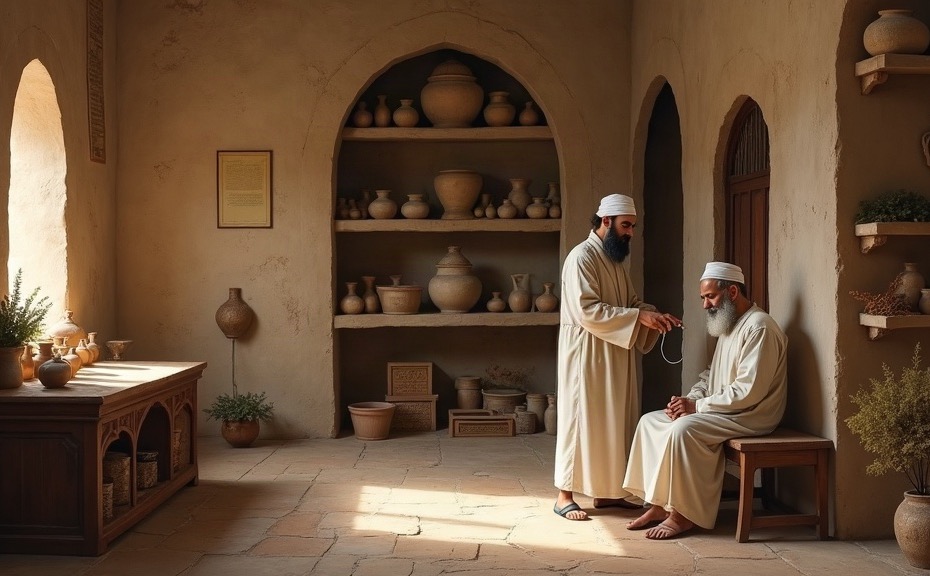
The Muslim world built true hospitals, called bimaristans, with separate wards, pharmacies, record-keeping and teaching, open to rich and poor alike. The medicine practised in them was written down in books that outlasted the buildings.
Al-Razi (Rhazes, around 865 to 925) was a sharp clinical observer who was the first to clearly distinguish smallpox from measles. Ibn Sina (Avicenna, 980 to 1037) gathered the medical knowledge of his age into the Canon of Medicine, which remained a standard textbook in European universities for roughly 600 years. In Cordoba, al-Zahrawi wrote a surgical encyclopaedia, complete with drawings of the instruments he invented, that helped found modern surgery.
Light, lenses and the first laboratories
Ibn al-Haytham's work on light did more than explain vision. It laid groundwork for the study of lenses and reflection that European scientists picked up centuries later, when his Book of Optics reached them in Latin. It is why he is often called the father of modern optics.
Chemistry took shape in the same period. Jabir ibn Hayyan, working in the 8th century, is remembered for turning alchemy toward careful, repeatable procedure. He and those who followed him refined distillation, crystallisation and the handling of acids, and built much of the standard laboratory apparatus. The words alcohol, alkali, alembic and alchemy all came into English from Arabic.
Ingenious machines
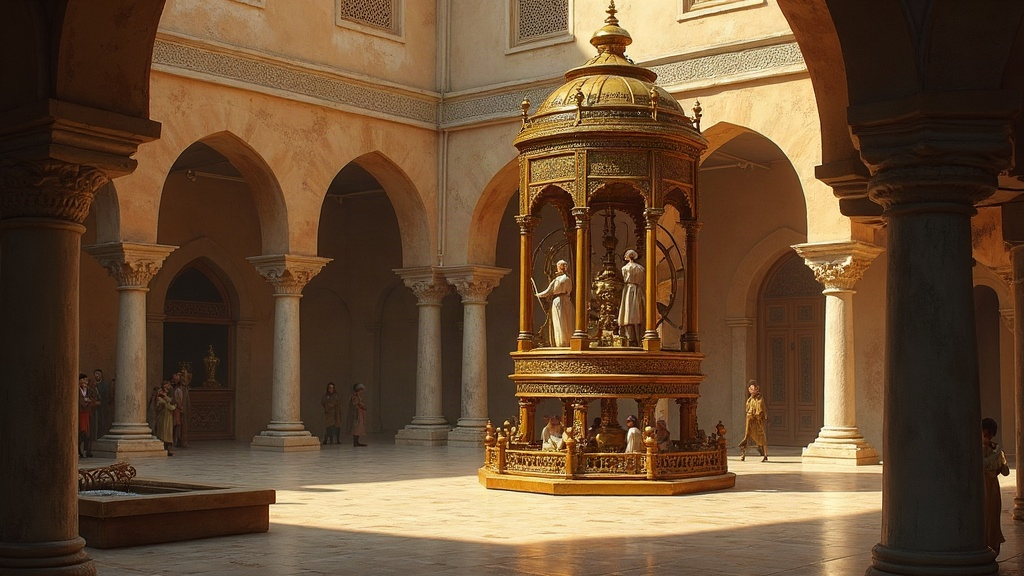
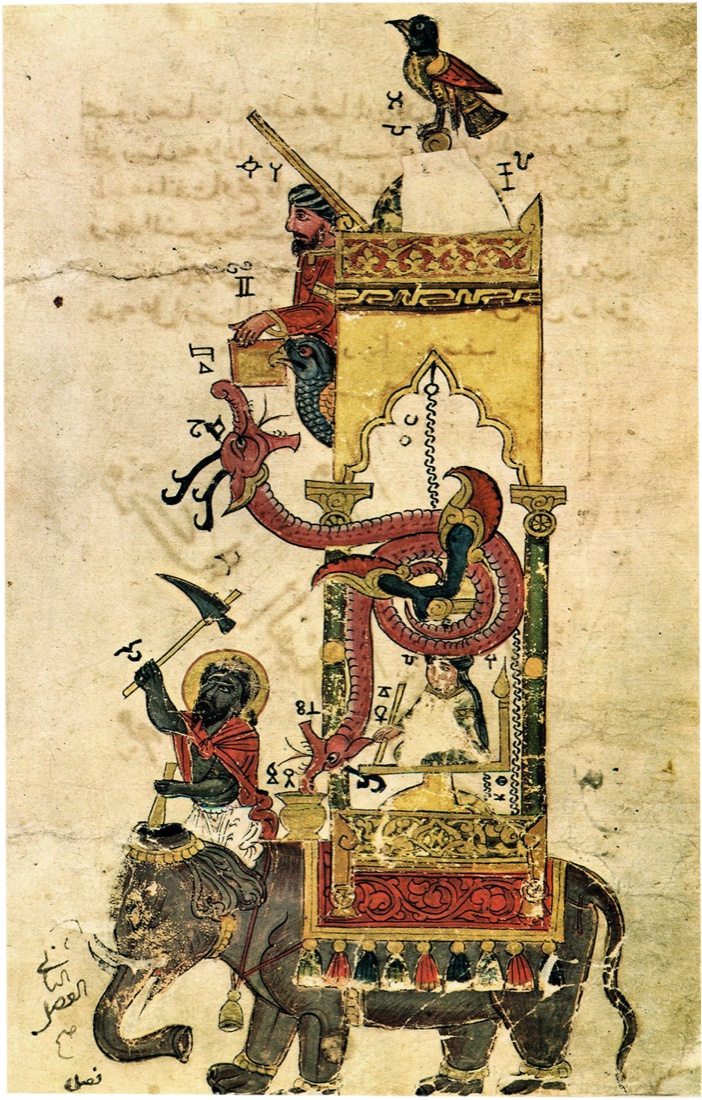
In 9th-century Baghdad, the three Banu Musa brothers wrote the Book of Ingenious Devices, describing around a hundred mechanical inventions, from trick fountains to self-adjusting instruments. Three centuries later al-Jazari went further. His Book of Knowledge of Ingenious Mechanical Devices (1206) described elaborate water clocks, automatic musicians and hand-washing machines, and along the way used crankshafts, camshafts and valves, components at the heart of machines to this day.
His most famous design was the elephant clock, a water-powered clock built as a working sculpture, combining an Indian elephant, Chinese dragons, an Egyptian phoenix and a Greek water mechanism into a single celebration of a connected world.
Mapping the sky and the world
Astronomy was the queen of the Islamic sciences. Observatories mapped the heavens with growing precision, and so many stars still carry Arabic names, among them Aldebaran, Altair and Betelgeuse. In 964, the astronomer al-Sufi recorded the Andromeda galaxy, the first known account of a galaxy beyond our own.
The same curiosity turned to the earth itself. Al-Biruni estimated the planet's circumference with striking accuracy, and the geographer al-Idrisi produced one of the finest world maps of the Middle Ages for the court of Sicily. Astronomy is a story large enough for its own page: read Islam and the stars.
How it reached us
None of this stayed in one place. From the 12th century, scholars in Toledo and Sicily translated Arabic science into Latin, and Europe studied it for centuries. Ibn al-Haytham shaped how Europeans thought about light and proof. Ibn Sina trained their physicians. Al-Khwarizmi taught them to calculate. This transmission is one of the threads that made the European Renaissance possible.
The debt is even in the vocabulary of science: algebra, algorithm, alcohol, alkali, cipher, zenith and nadir all came from Arabic. The Islamic Golden Age was not a detour in the history of science. It was one of its main roads.
Learn Islamic history with Archives
Archives turns 1,400 years of Islamic history, including the scientists on this page, into one short, true story a day. Sourced, built to stick, and made for people who want to understand their history without wading through textbooks.


Who writes these guides
History is only worth reading if it’s true, so here is who writes it.

“So much of what we call modern science was carried, and often born, in the Muslim world. I want people to know these names as well as they know Newton and Galileo.”
Islamic science: frequently asked questions
What is Islamic science?
The scientific work done across the Muslim world, mainly during the Islamic Golden Age (roughly the 8th to 13th centuries). Scholars writing chiefly in Arabic gathered Greek, Persian and Indian knowledge, tested and corrected it, and made original advances in mathematics, astronomy, medicine, optics, chemistry and engineering.
Who were the greatest Muslim scientists?
Among the most important: al-Khwarizmi (algebra), Ibn al-Haytham (optics and the experimental method), Ibn Sina (the Canon of Medicine), al-Razi (clinical medicine), al-Zahrawi (surgery), Jabir ibn Hayyan (chemistry) and al-Jazari (engineering).
What did Islamic scholars invent or discover?
Algebra and the word algorithm, the spread of the numeral system and zero, the experimental method in optics, the camera obscura principle, advances in distillation and laboratory chemistry, medical encyclopaedias and surgical instruments, accurate star catalogues, and machines using cams, crankshafts and valves.
Did Islamic science influence modern science?
Yes. From the 12th century, Arabic works were translated into Latin in Toledo and Sicily and studied across Europe, helping make the Renaissance possible. Read how the era worked in the Islamic Golden Age.
Keep exploring
More of the story, on the web and in the app.