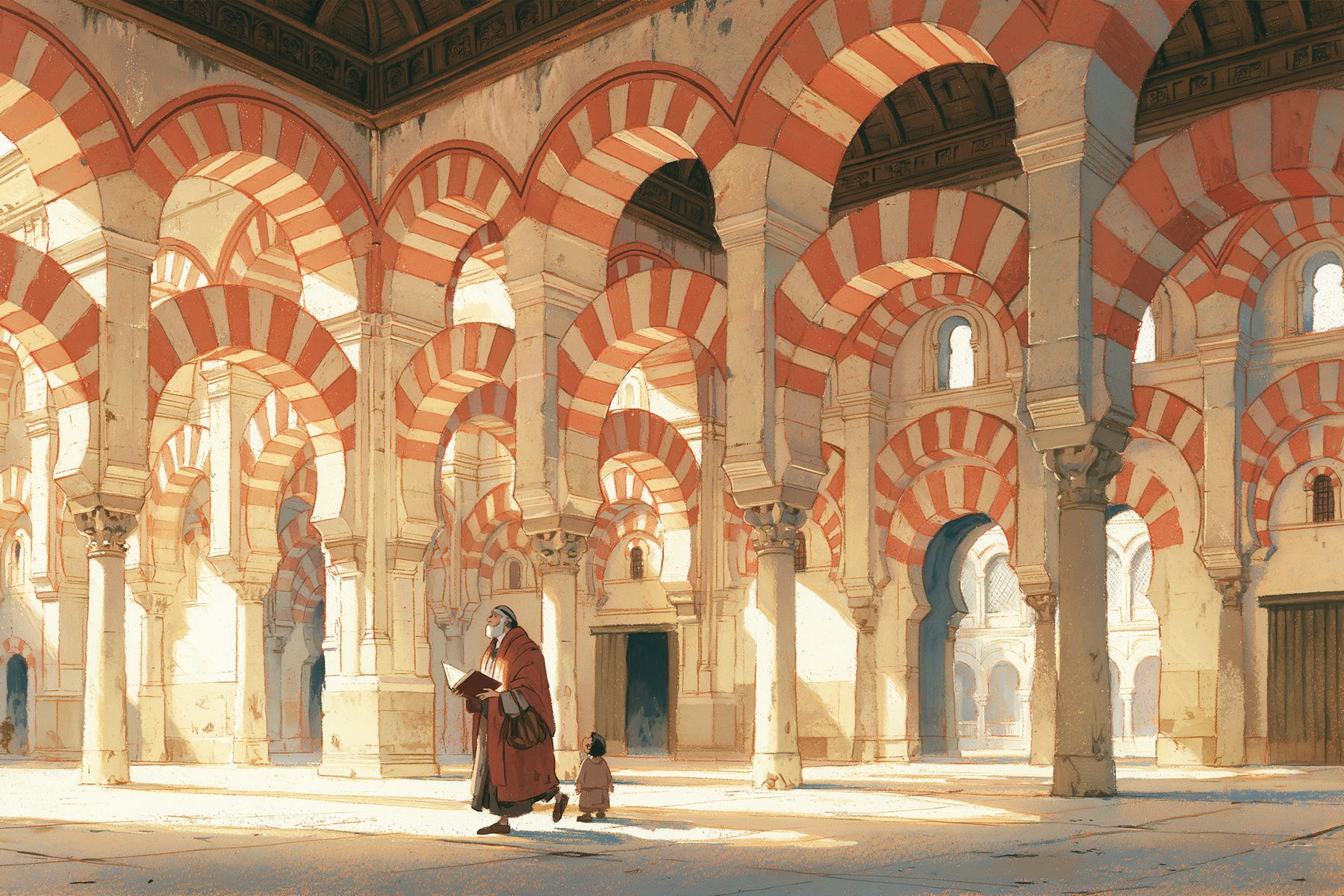
711 – 929
The Rise
A small army crosses the strait, a hunted prince builds a kingdom, and Cordoba grows into the brightest city in the West.
Playable now in ArchivesFor nearly 800 years, Islam shaped the Iberian Peninsula. This is the history of Muslim Spain, the land its people called Al-Andalus: its cities of light, its scholars, and its long twilight, from Tariq ibn Ziyad’s crossing in 711 to the last Moriscos in 1614. One clear story, told in short videos with a quiz after each chapter.
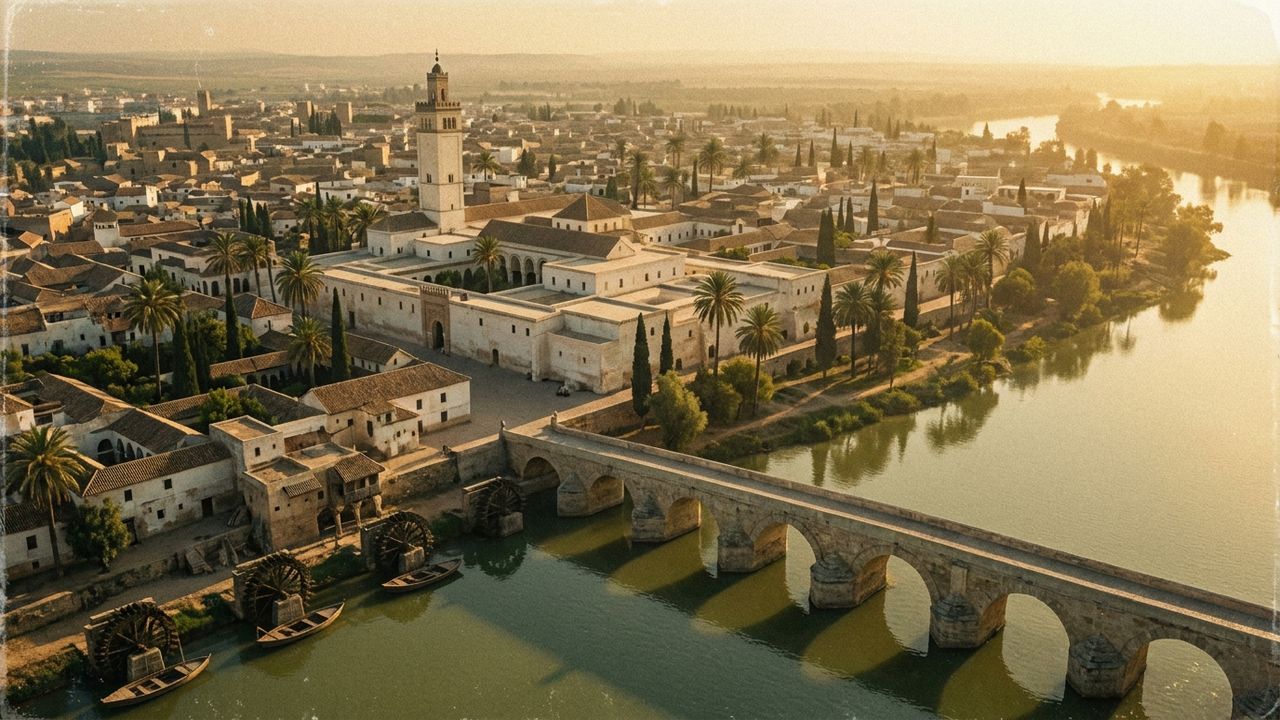
Al-Andalus is the name for the parts of the Iberian Peninsula (today’s Spain and Portugal) that lived under Muslim rule between 711 and 1492. At its height it was one of the most advanced societies in Europe. A farmer in Cordoba drank from running water; a doctor there wrote the surgical textbook the rest of the continent would study for five centuries; the city’s libraries held more books than all of Western Europe combined.
The history of Islamic Spain usually gets told as a single golden blur. It actually runs through three very different chapters over almost eight centuries: a hard-fought rise, a dazzling peak, then a slow and dignified decline. The people who lived it called themselves Andalusis; their Christian neighbours called them Moors. What they built still stands, from the red towers of the Alhambra in Granada to the endless arches of the Great Mosque of Cordoba.
This page walks through the whole story of Muslim Spain in order, so you can see how one afternoon in 711 turned into a civilisation, and why it ended 900 years later.
Eight centuries, three acts. Here is the shape of the whole story before we walk through it.
A small army crosses the strait, a hunted prince builds a kingdom, and Cordoba grows into the brightest city in the West.
Playable now in Archives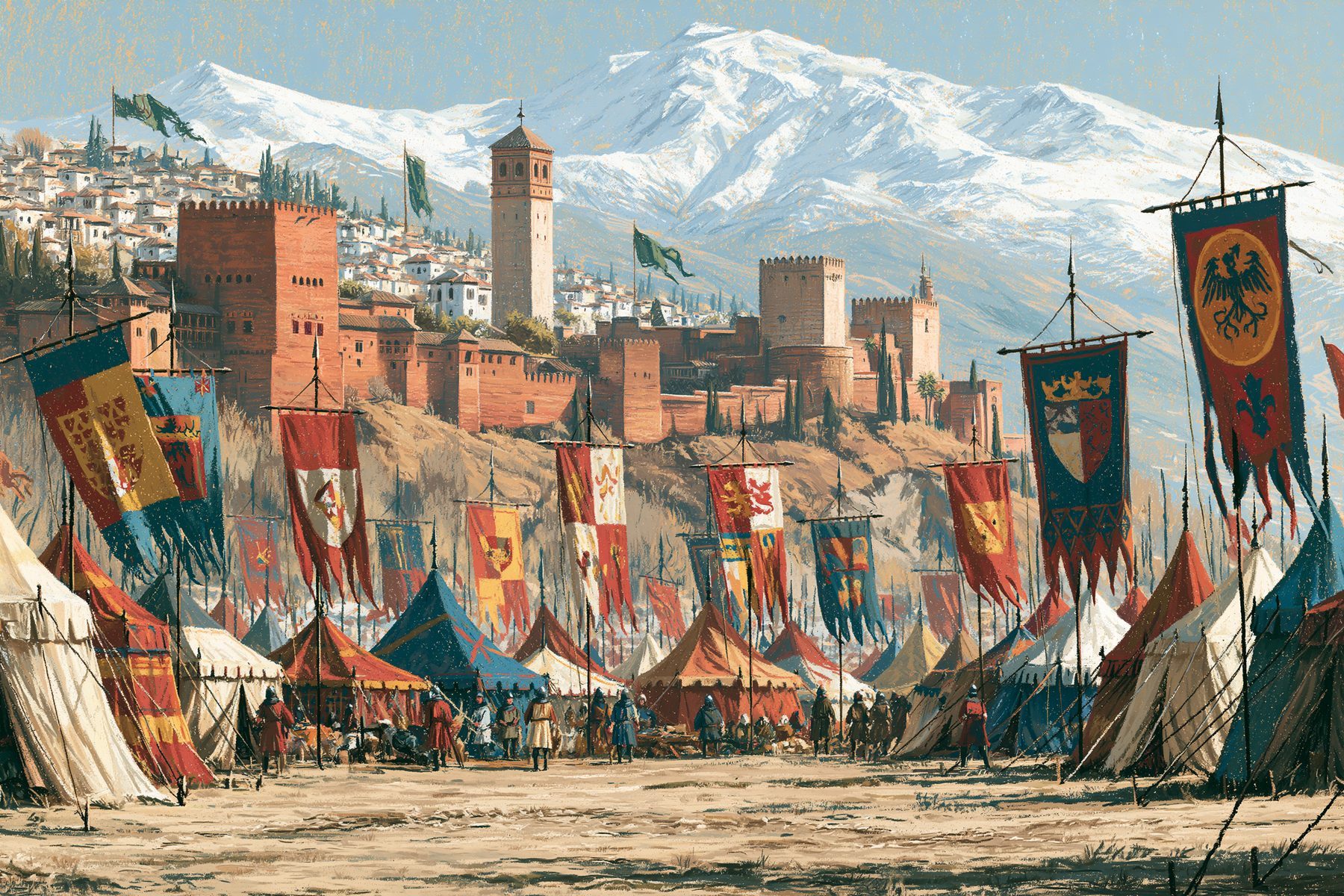
Cordoba declares a caliphate and shines brightest, then splinters into rival kingdoms as its greatest scholars change the world.
Coming to Archives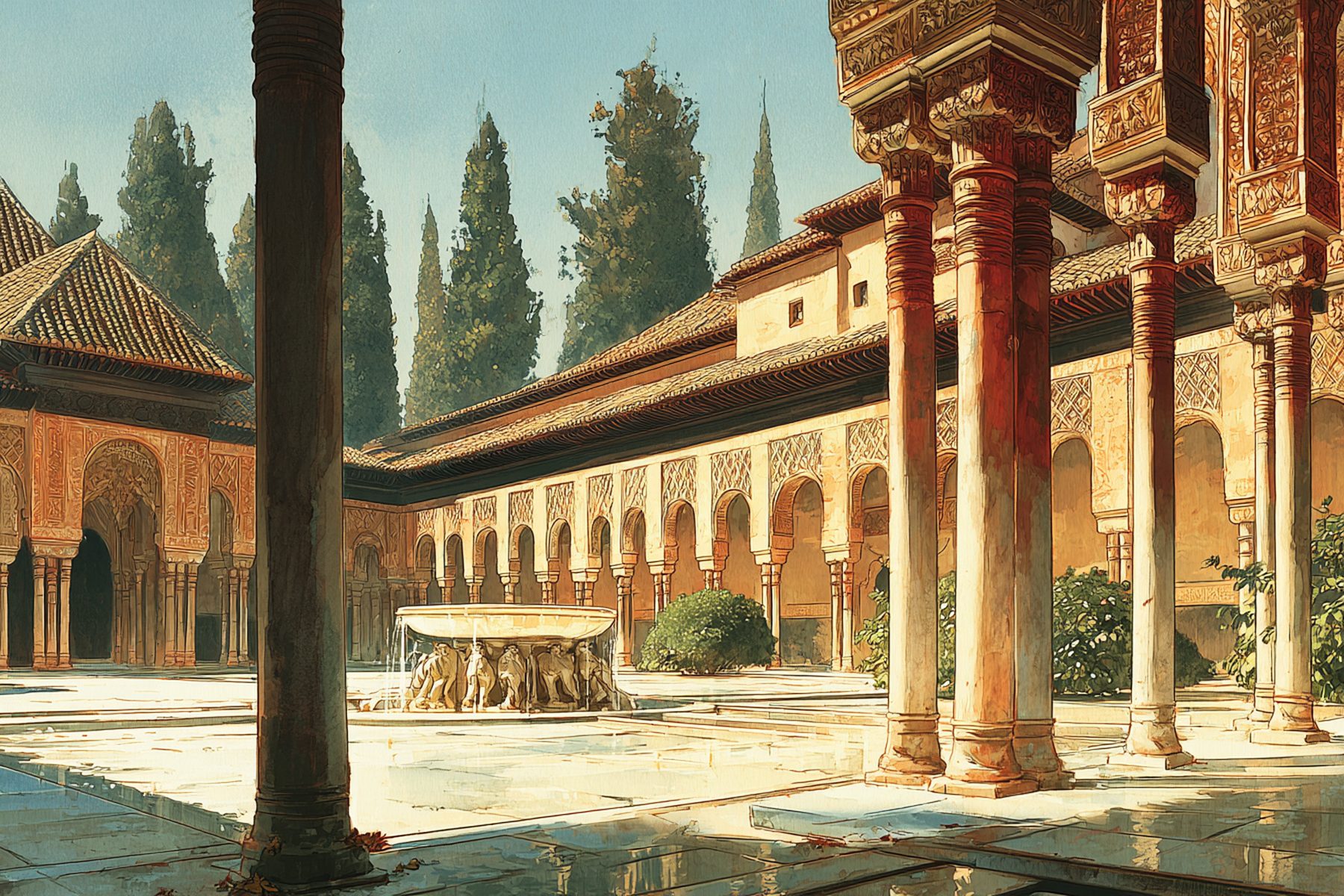
One kingdom is left. For 250 years Granada survives by being clever and beautiful, until the keys are handed over and a faith goes into hiding.
Coming to Archives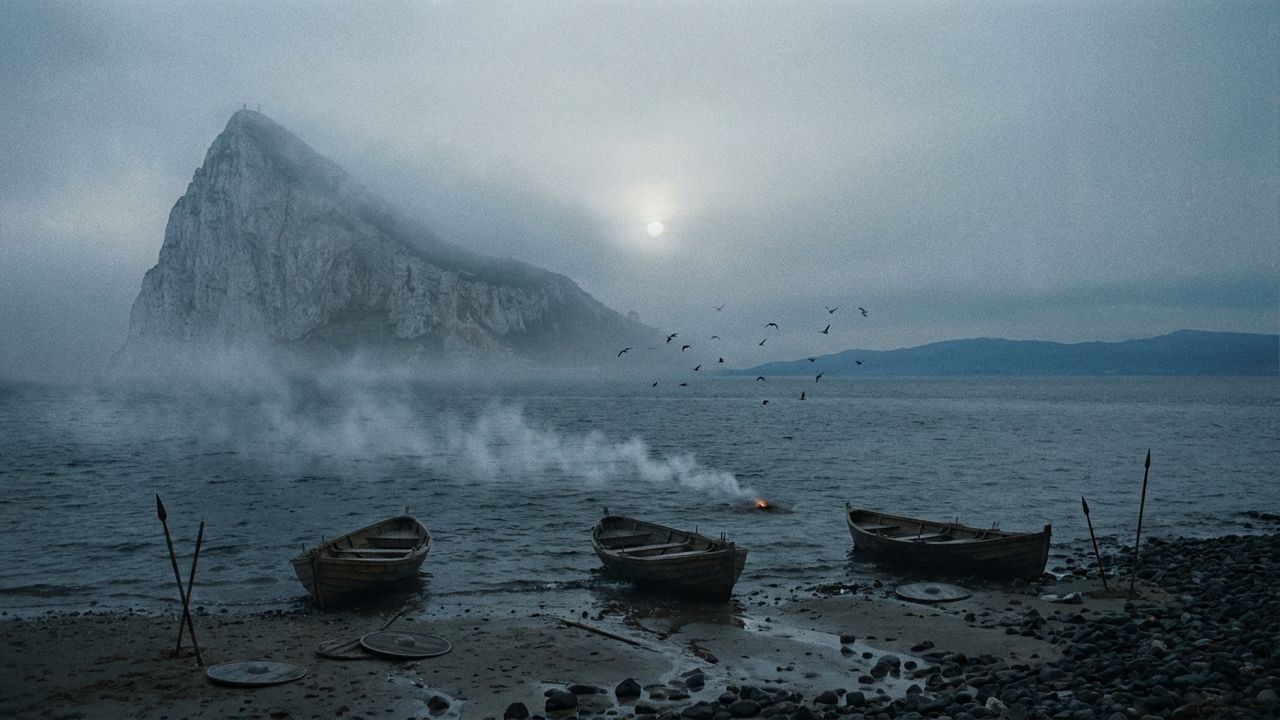
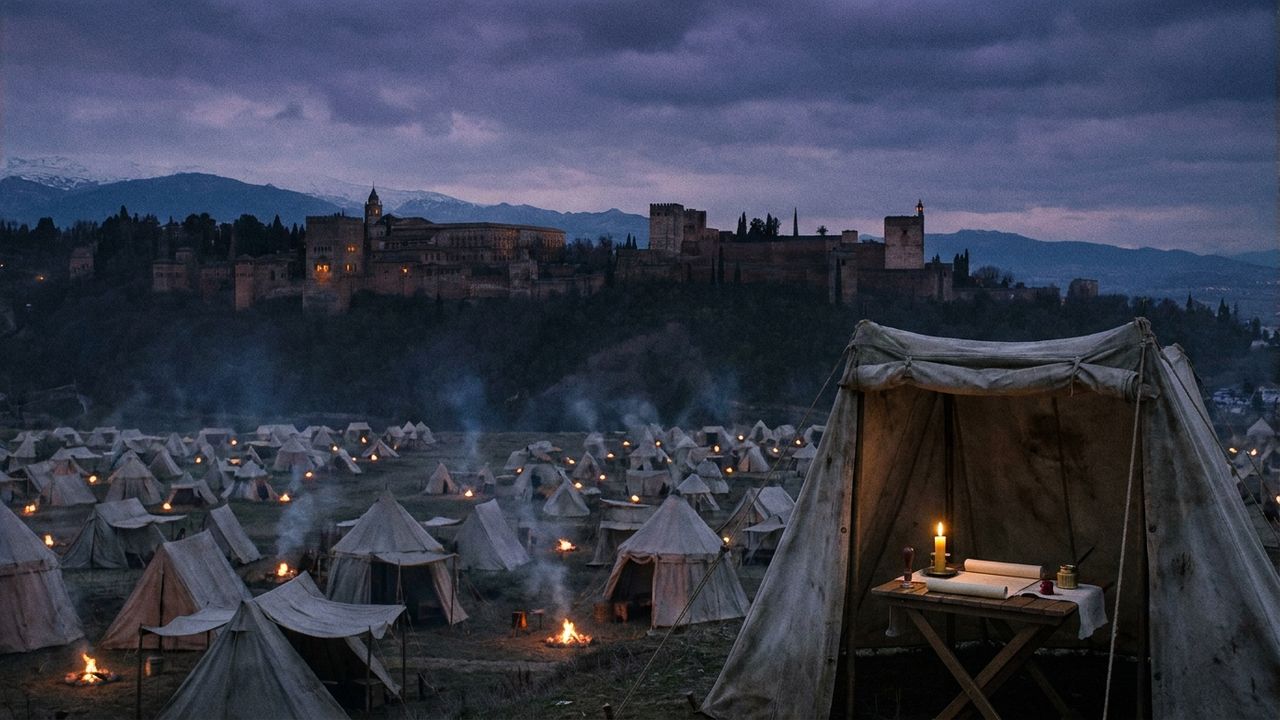
In the spring of 711, a mostly Berber army of a few thousand crossed the eight-mile strait between North Africa and Spain under a commander named Tariq ibn Ziyad. The rock where he landed still carries his name: Jabal Tariq, or “Tariq’s Mountain,” which softened in European mouths into the word we use today, Gibraltar. At the Battle of Guadalete that July, Tariq’s force met the Visigothic king Roderic and ended three centuries of rule in a single afternoon.
What followed was less a conquest by fire than by contract. In 713 the Visigothic lord Theodemir signed a treaty that kept his lands, his churches and his people in exchange for a yearly tax. It was one of the most remarkable peace deals of the Middle Ages, and the same bargain repeated across the peninsula. Within a decade most of Iberia was Al-Andalus.
Then came the story that reads like an adventure novel. In 750 the Umayyad dynasty was massacred in the East. A nineteen-year-old prince, Abd al-Rahman I, escaped across three seas and a desert, reached the far western edge of the Muslim world, and in 756 founded an independent emirate at Cordoba. His own people called him the Falcon of the Quraysh. Over the next century and a half his descendants turned a frontier town into the cultural capital of the West. They began the vast Great Mosque of Cordoba, laid out gardens fed by engineered water, and welcomed a Baghdad musician named Ziryab who reset the city’s taste in everything from food to fashion. The first scholars gave Al-Andalus its law, its written history, and its first daring questions about the world. One of them, Abbas ibn Firnas, built a flying machine and jumped from a Cordoban hillside, seven centuries before Leonardo sketched one.
It nearly didn’t survive. The young emirate came through at least five threats to its existence, from rebellions and invasions to a direct showdown with the Abbasids of Baghdad, before Cordoba was steady enough to think about a crown. That crown is where the next era begins.
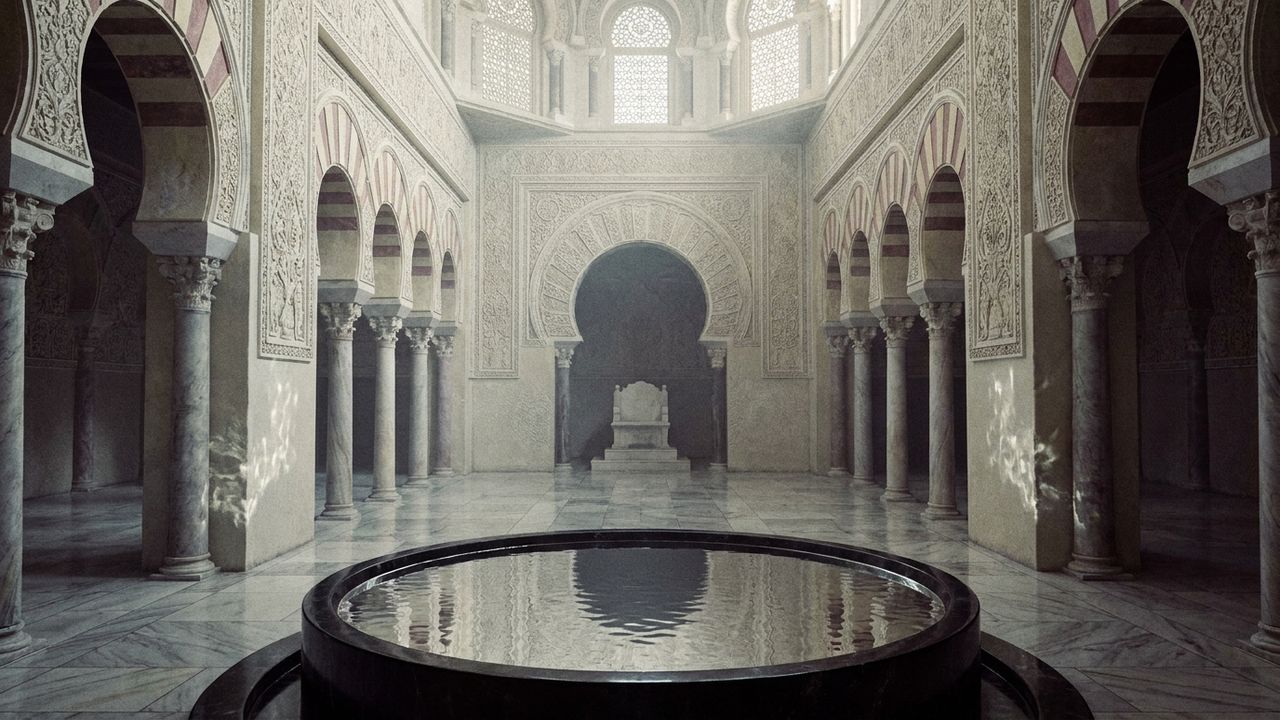
In 929, Abd al-Rahman III did what his ancestors never dared: he declared himself Caliph, making Cordoba the seat of a state that answered to no one. Just outside the city he raised Madinat al-Zahra, a brand-new palace-city so ambitious that ten to fifteen thousand workers built it every day for forty years, at times swallowing a third of the treasury. Cordoba itself was the largest and best-lit city in Europe, its streets paved and lamplit while other capitals were still mud and curfew. His son al-Hakam II gathered a library said to hold hundreds of thousands of volumes, at a time when a rich northern monastery counted its books in the dozens.
That height did not hold. A ruthless general, al-Mansur, seized real power from a boy-caliph and in 997 marched all the way to Santiago de Compostela, carrying its cathedral bells back to Cordoba on the shoulders of Christian captives. When his line collapsed the caliphate turned on itself, and after 1031 it shattered into more than thirty small kingdoms, the Taifas. Oddly, that fracturing produced a second spring of art: rulers like al-Mutamid of Seville were poets as celebrated for their verse as for their armies. When Christian kings pressed south, Berber dynasties from the desert, the Almoravids and then the Almohads, crossed over to hold the line for another century.
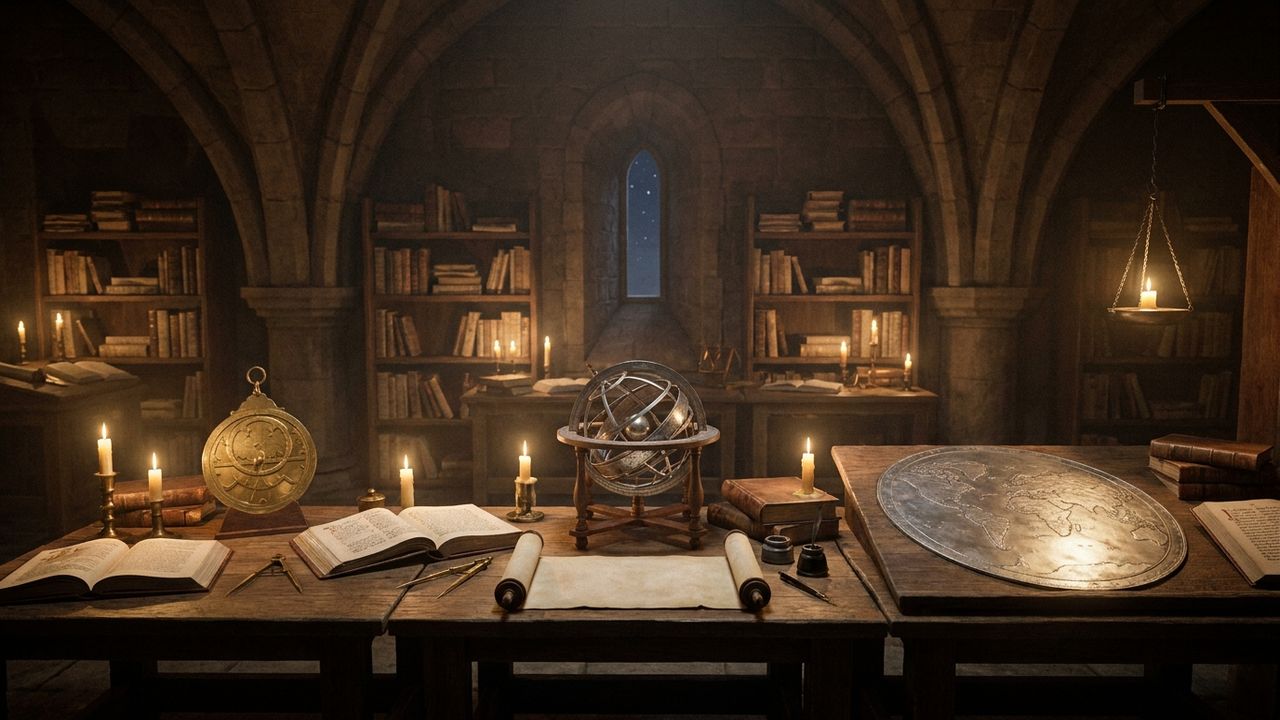
Above the politics, the minds of Al-Andalus were rewriting what Europe knew. Al-Zahrawi wrote a surgical encyclopaedia that European medical schools used for 500 years. Al-Zarqali, a Toledo instrument-maker who taught himself astronomy from the books he engraved tools for, built star-tables copied across the continent. Ibn Tufayl wrote Hayy ibn Yaqzan, the story of a child raised alone on an island who reasons his way to the truth, centuries before Robinson Crusoe. And Averroes, born Ibn Rushd of Cordoba, wrote commentaries on Aristotle so influential that Latin Christendom simply called him “The Commentator.” That, more than any palace, is what made Al-Andalus famous.
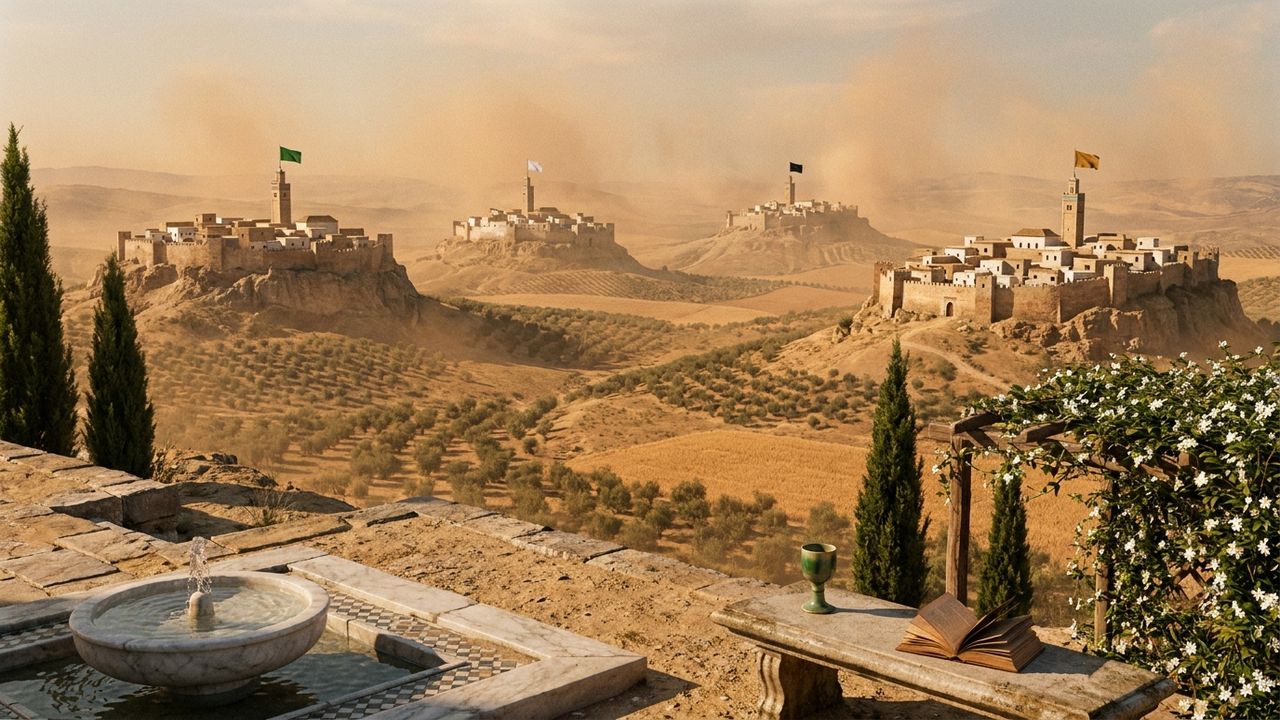
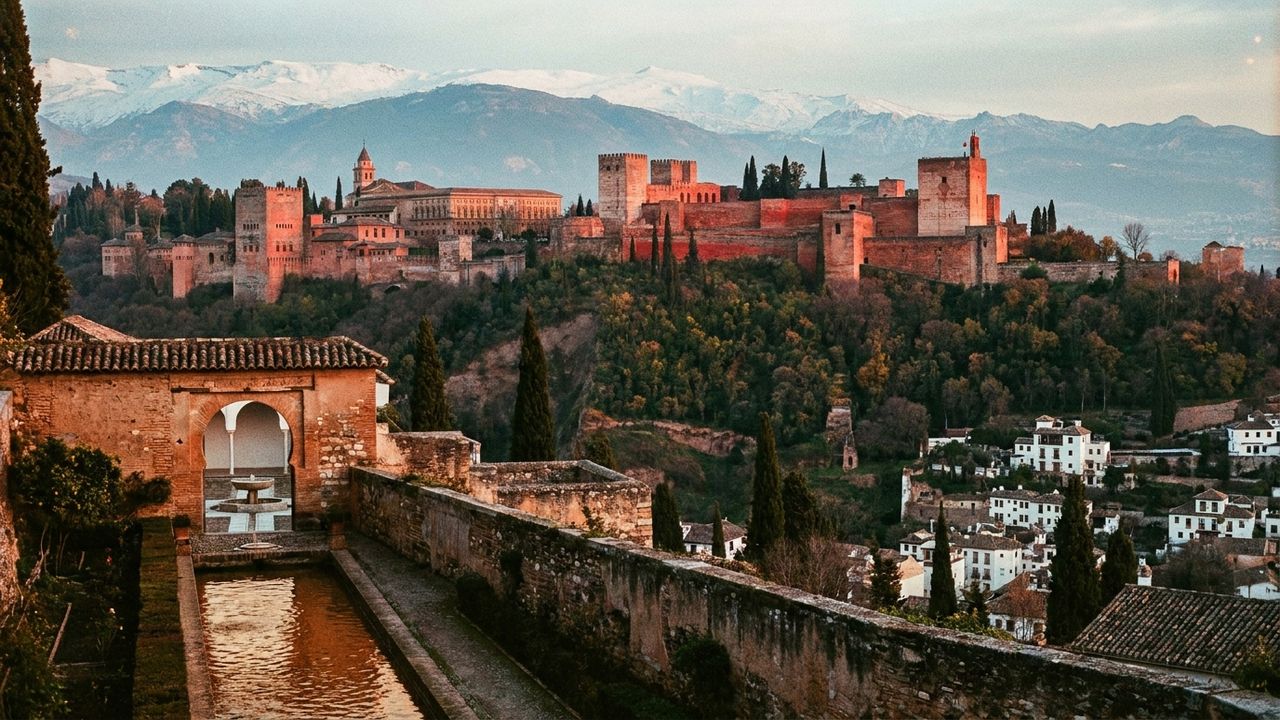
The turning point came at Las Navas de Tolosa in 1212, where a combined Christian army broke the Almohads. City after city fell, Cordoba in 1236, Seville in 1248, until only one Muslim kingdom was left. In 1232 a leader named Muhammad I al-Ahmar, “the Red,” climbed the Sabika hill above Granada and founded the Nasrid emirate, the last in Spain. For 250 years Granada survived the way a smaller power always must, through diplomacy, tribute and sheer beauty. On that same hill the Nasrids built the Alhambra, the “Red Castle,” whose courtyards and honeycombed ceilings remain among the most visited rooms on earth. Its walls carry no battle scenes, only poems.
Granada spent those centuries as a refuge for learning. The court poet Ibn Zamrak had his verses carved onto the Alhambra’s walls, where they still are. The physician and vizier Ibn al-Khatib, writing in the middle of the Black Death, argued that the plague spread by contagion, centuries before the idea took hold. But the north was closing in. In 1469 Isabella of Castile married Ferdinand of Aragon, fusing two rival crowns into one with a single aim: finish the Reconquista.
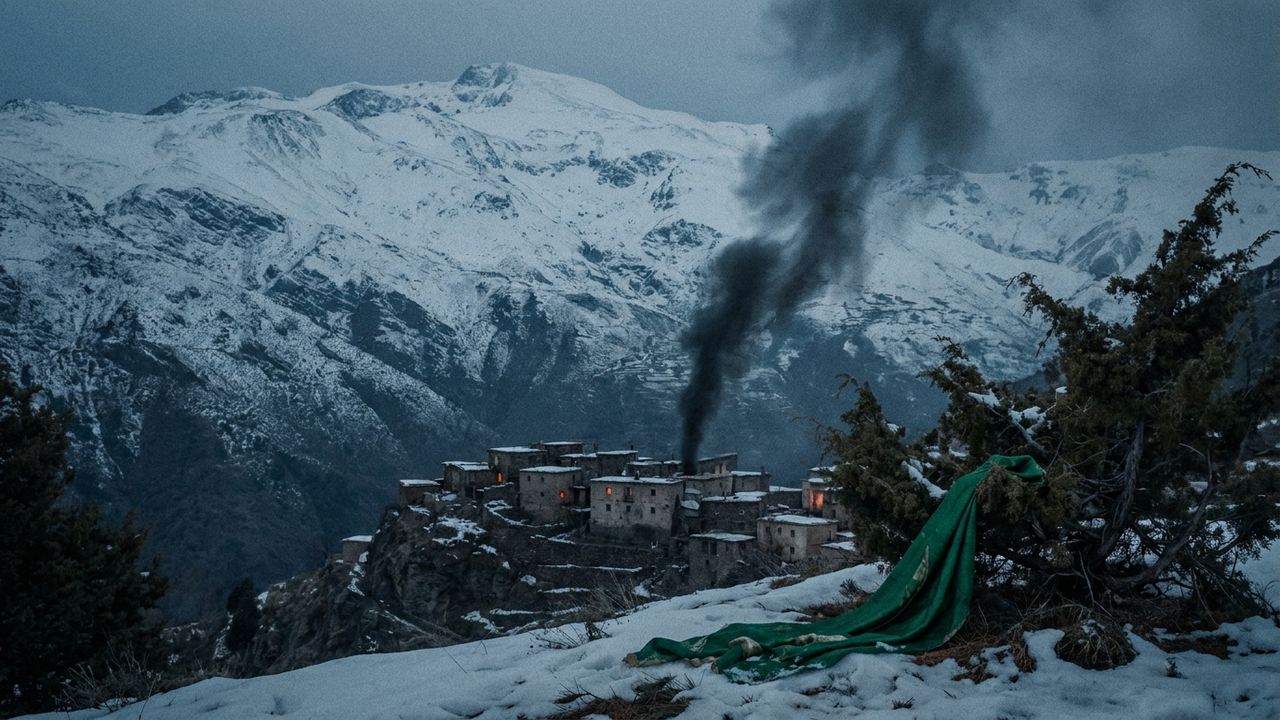
In 1492, the same year Columbus sailed, the last sultan Muhammad XII, known as Boabdil, handed the keys of Granada to Ferdinand and Isabella. The surrender treaty, the Capitulations, promised Muslims their faith, their language and their books. For a few years, under the gentle archbishop Talavera, it mostly held. Then it was torn up: conversion was forced, Arabic books were burned in the squares, and those who converted became known as Moriscos. For a hundred years they kept a hidden faith in mountain villages, rose in revolt across the Alpujarras, and were finally expelled from Spain between 1609 and 1614. That was the quiet, painful end of Al-Andalus.
What remained was not nothing. The language kept thousands of Arabic words. The rice, the oranges and the irrigation stayed in the fields. And the books, translated in places like Toledo, carried Andalusi science north into the Renaissance. The kingdom ended; its knowledge did not.
The names and landmarks that carry the whole history of Islam in Spain.
The Berber commander who crossed the strait in 711 and gave his name to Gibraltar.
The exiled Umayyad prince, “the Falcon,” who founded the Emirate of Cordoba in 756.
A forest of red-and-white arches, begun in 785 and expanded for two centuries.
Hundreds of thousands of volumes, when the rest of Europe counted books in dozens.
The surgeon and the philosopher whose work Europe studied for 500 years.
The Nasrid “Red Castle,” the last and most beautiful seat of Muslim Spain.
Archives is a learning app for Islamic history. Think Duolingo, but for the story of your own civilisation. The whole of Al-Andalus is built into it as short, sourced chapters, each with a video and a quick quiz so it actually sticks.
A real moment in the history of Muslim Spain, like Tariq’s crossing or the rise of Cordoba, told as a short, cinematic video.
A handful of questions after each chapter, each with a plain-language explanation, so the facts move into memory.
Chapters unlock era by era, from 711 onward, so you always have the context before the next twist.
Five adventures you can play right now: the opening era of Al-Andalus, start to finish.
A tiny army crosses the strait and wins a kingdom in an afternoon.
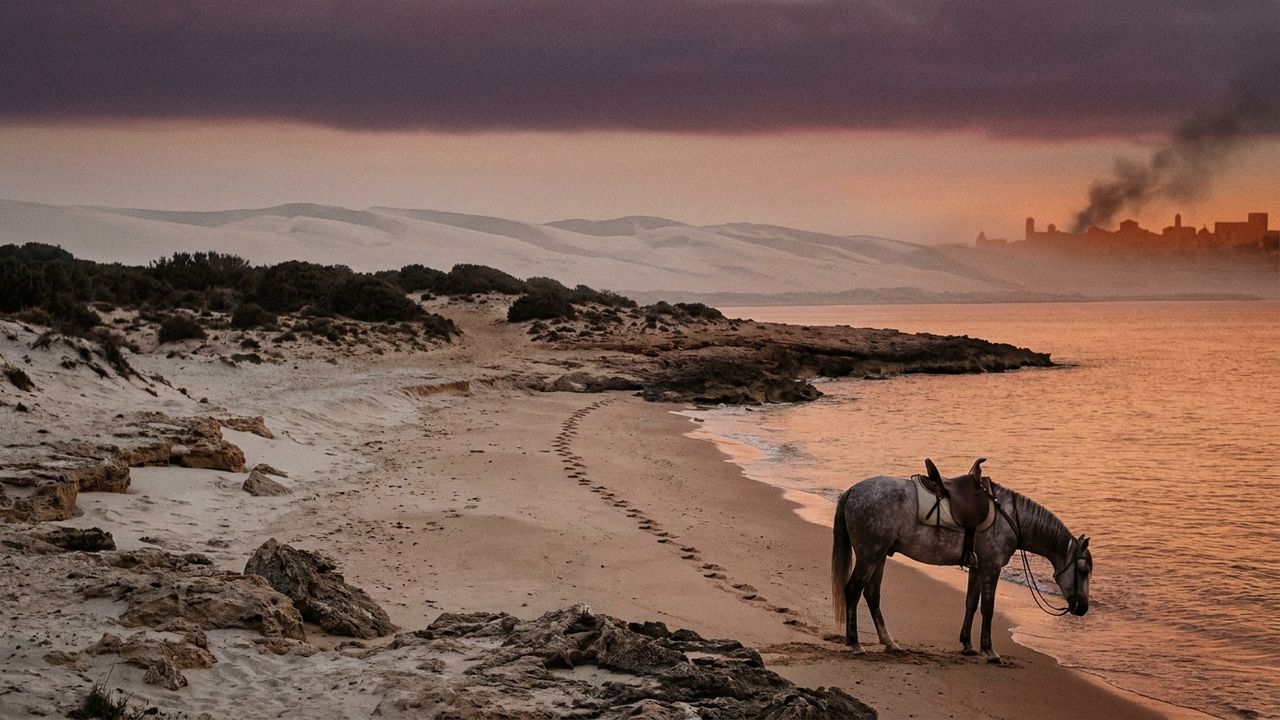
A hunted teenage prince builds a new kingdom at the edge of the world.
Cordoba blooms into Europe’s brightest city of poets, scholars and gardens.
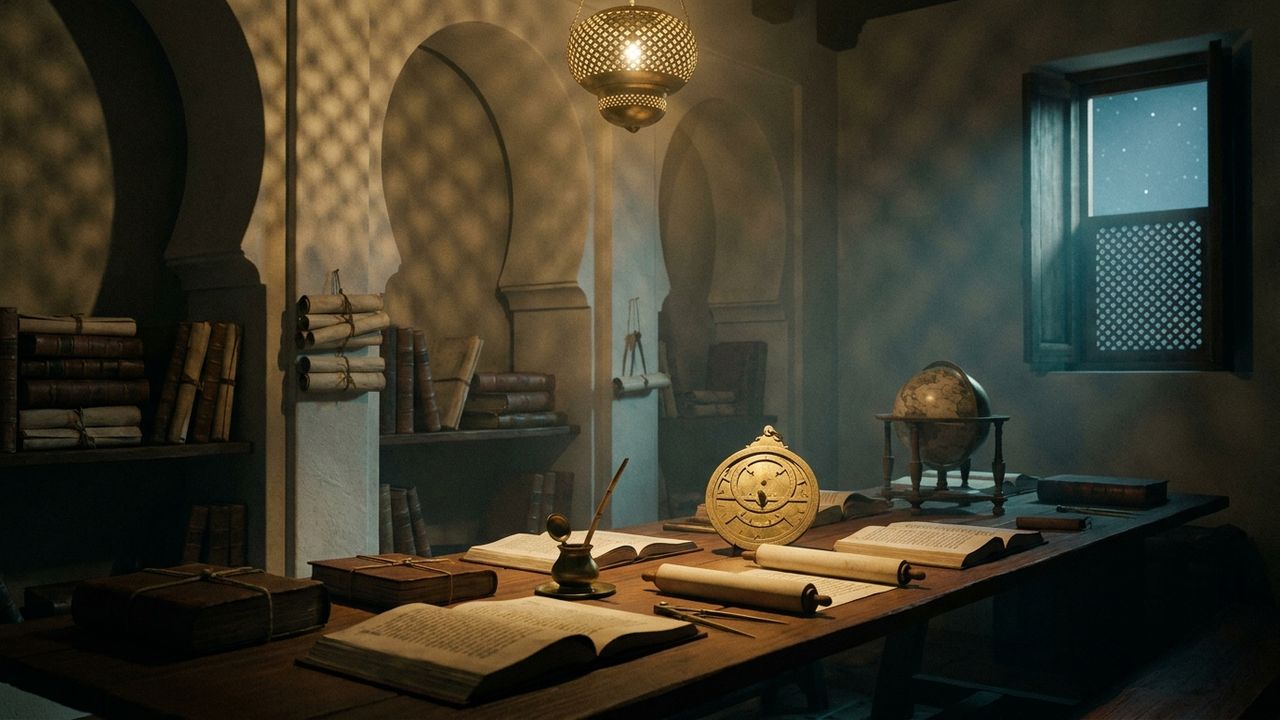
The thinkers who gave the kingdom its law, its history and its science.
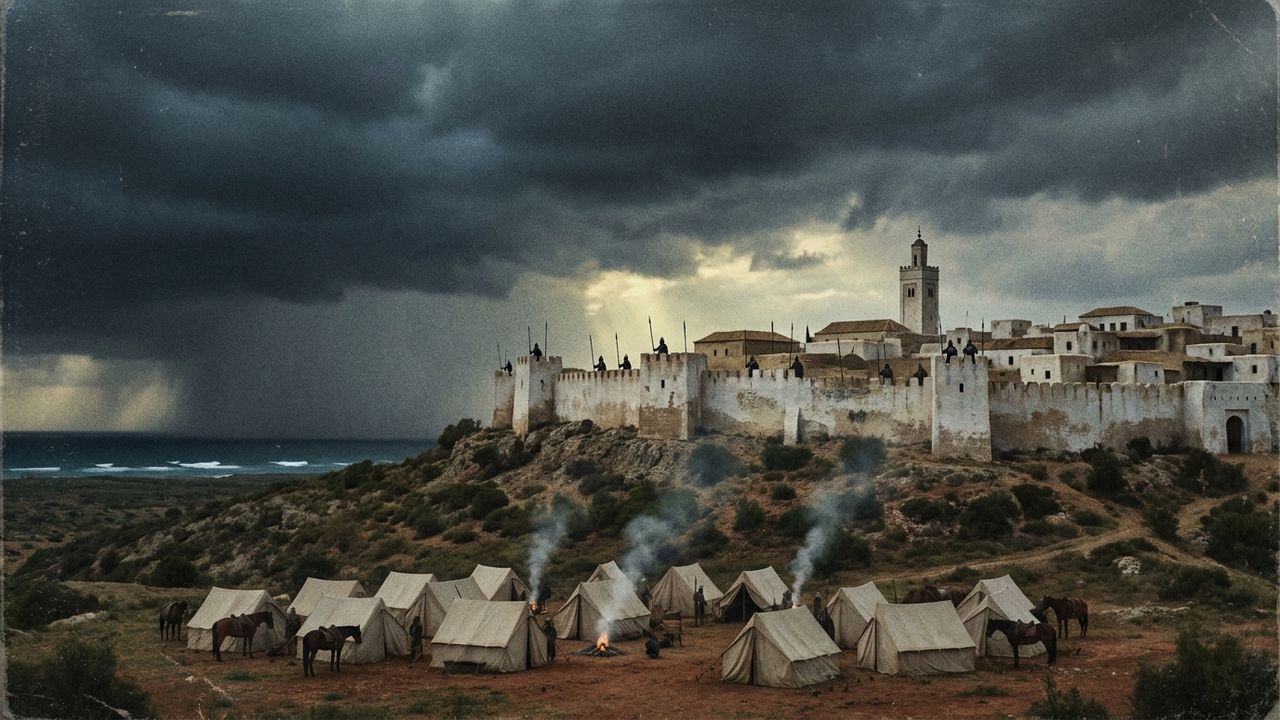
The five terrifying threats the young emirate barely survived.
A taste of how the story is told inside the app. Tap to play.
A few questions straight from the Al-Andalus chapters. Tap an answer to see if you’re right, and why.
History is only worth learning if it’s true, so here is who writes it.

“Al-Andalus is the part of our history most people feel they should know and never got taught properly. I wanted to give it back: accurate, in order, and short enough that anyone can actually finish it.”
Every chapter of the Al-Andalus story is built from historical accounts rather than legend. Where historians disagree (about the size of an army, say, or whether a famous treasure ever really existed) the story says so, instead of picking the most dramatic version.
Islam reached Spain in 711 CE, when a mostly Berber army led by Tariq ibn Ziyad crossed the Strait of Gibraltar and defeated the Visigothic king Roderic at the Battle of Guadalete. Within a few years most of the Iberian Peninsula was under Muslim rule and became known as Al-Andalus.
About 781 years, from the conquest in 711 to the fall of Granada, the last Muslim kingdom, in 1492. Muslim communities known as the Moriscos remained in Spain for another century, until their final expulsion was completed around 1614.
Al-Andalus was the name for the parts of the Iberian Peninsula (modern Spain and Portugal) under Muslim rule between 711 and 1492. At its height it was one of the most advanced societies in Europe, centred on the city of Cordoba.
The Caliphate of Cordoba broke apart into small rival kingdoms, the Taifas, after 1031, leaving Muslim Spain divided. Christian kingdoms in the north pushed south over centuries in the Reconquista, winning a decisive victory at Las Navas de Tolosa in 1212. The last kingdom, Granada, surrendered in 1492.
For the city of Cordoba and its Great Mosque, for libraries holding hundreds of thousands of volumes, for scholars such as Averroes (Ibn Rushd) and the surgeon Al-Zahrawi, for advances in medicine, mathematics, astronomy and agriculture, and for landmarks like the Alhambra in Granada.
Archives teaches the history of Islamic Spain as short, sourced five-minute chapters with videos and quick quizzes, on the web and as an app for iOS and Android. It is free to start and begins at the very beginning, so no background is needed.
More ways into the history of Islam, on the web and in the app.